
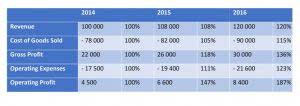
An example of a multi step income statement is Arrow Electronics, Inc.’s Consolidated Statements of Operations for the calendar years ended December 31, 2021, 2020, and 2019. It’s available as a 10-K company filing in the SEC’s EDGAR database dated February 11, 2022. This statement is a valuable tool for preparing and analyzing financial performance. Let us understand how to prepare multi-step income statement and how to identify the items that should be included under each head. In short, the introduction of stakeholders for the first time is typically the catalyst for private companies to transition from the single-step to https://www.rndemo.co.in/2022/08/09/what-is-an-ein-does-your-business-need-one-how-to/ multiple-step income statement.
What are the 3 Main Parts of a Multi Step Income Statement?
- Single-step income statements calculate the business’s net income by subtracting losses and expenses from gains and revenue.
- Net income is a crucial indicator of a company’s financial health and performance.
- Understanding Net Income provides the clearest picture of a company’s financial success, offering a holistic view that considers all revenue streams and every type of expense.
- Having distinguished between the multi-step and single-step income statements, we can now embark on the journey of building the multi-step statement, starting with its foundational element.
- The multi-step format lists components like revenue, cost of goods sold, operating expenses, interest, and taxes in distinct sections.
Having the additional breakdown is useful for lenders and investors to understand the business better and decide whether a company is worth working with. Apply these principles to enhance your financial literacy, refine your strategic planning, and consider consulting with accounting professionals or delving deeper into detailed GAAP principles from FASB resources. Accumulated depreciation is a contra-asset account that is reported on the balance sheet. It is for all prior years and is not the same as depreciation expense which is the expense related to using the asset for this year only. 7) The company incurred $800 of interest expense in January that won’t be paid until March.

Calculate Operating Income

While detail can be beneficial, there’s a risk of getting bogged down in the minutiae. Too much focus on the many categories might lead to overlooking broader trends or overarching business strategies. Fundamentally, the basic premise of either presentation format is conceptually the same, granted the outcome of either method is to multiple step income statement arrive at net income. My Accounting Course is a world-class educational resource developed by experts to simplify accounting, finance, & investment analysis topics, so students and professionals can learn and propel their careers.
Secondary-Activity Expenses
- The income statement is one of a trio of essential financial statements, including the balance sheet, which lists a company’s assets and liabilities, and the cash flow statement.
- This can help in identifying potential inefficiencies in production or procurement.
- The multi-step income statement details the gains or losses of a business, in a specific reporting period.
- Gross Profit – The gross profit section lists the sales for the period and subtracts the discounts and returns followed but a subtotaled called net sales.
- Finance and accounting professionals will also use the multi-step income statement to compare between companies, as it allows for comparisons for the gross profit margin or the operating profit margin.
The single-step income statement, known for its simplicity, combines all revenues and expenses into single categories to calculate net Oil And Gas Accounting income directly. This format is suited for smaller businesses or those seeking a straightforward financial overview. In contrast, the multi-step income statement provides a detailed breakdown of operational and non-operational activities, offering a nuanced view of a company’s financial performance. This format is preferable for larger or more complex businesses that require an in-depth analysis of their financial operations.

- At its core, a Multi-Step Income Statement is a sophisticated financial report designed to dissect a business entity’s revenues and expenses into various categories, ultimately revealing profitability at multiple stages.
- It is a more detailed alternative to the single-step income statement and uses multiple equations to calculate a business’s net income.
- The calculation steps are clarified via the ‘+’ and ‘−’ symbols on the left of various income and expense items.
- Gross profit reflects the amount of revenue remaining after covering the direct costs of producing the goods or services sold.
- This figure represents the earnings before interest and taxes (EBIT) for Microsoft’s core business activities.
- For instance, if your business is charged with 10% of tax expense from a total of $60,000 of net income, thus, your business will have to bear $6,000 of tax expense.
- Reiterating the ongoing importance of accurate data collection and strict adherence to U.S.
The operating section is subdivided into two main sections that list the primary business income and expenses. The first section computes the gross profit of the business by subtracting the cost of goods sold from the total sales. This is a key figure for investors, creditors, and internal management because it shows how profitable the company is at selling its goods or making its products. By separating operating and non-operating activities, it’s easier to assess the core business’s performance.
